Drone technology in the last few years has gone from a hot new commodity to what many may deem essential to achieving yield goals. Stine® Seed Company has been maximizing this technology by using it for product research. Here’s a closer look at how Stine uses this aerial innovation to study the products and agronomic practices that will improve your yield in 2026.
Clearer view of crop performance
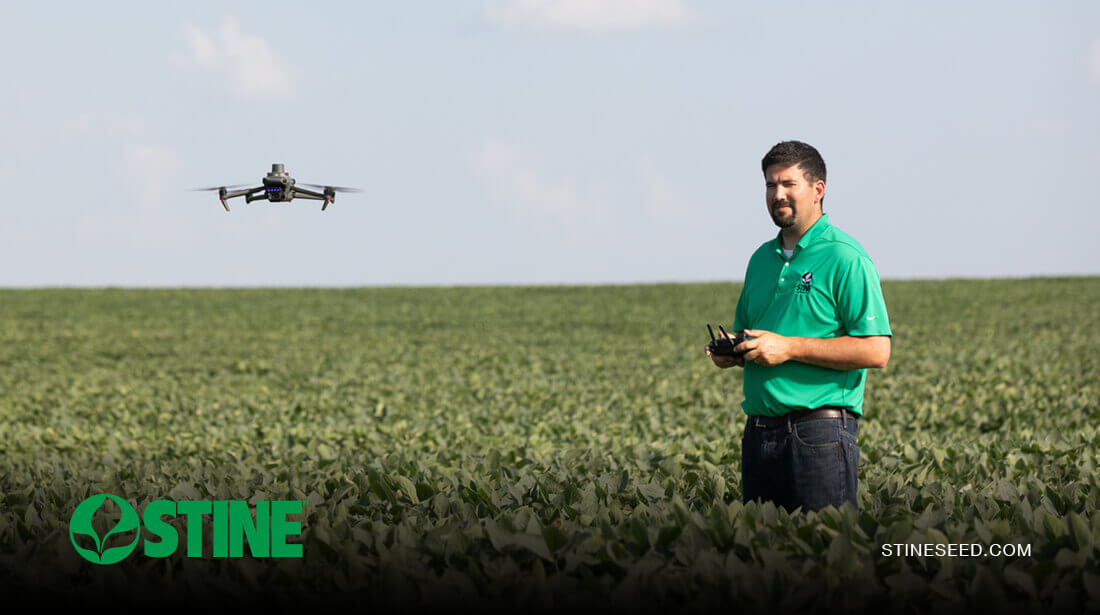
Drones have made product research and crop scouting much easier.
On the research side, Stine’s research and development (R&D) experts have been using drones for several years to evaluate product performance over entire fields and generate a bank of images for AI leveraging in future cycles. Drone technology is integrated into our Elite Yield Trials and field plot programs to provide a comprehensive picture of how products perform, from emergence through harvest. It helps track crucial stand counts for yield analysis, provides critical information through vegetative indexes and analytics for crop health. It also provides insight on hybrid or variety tolerances to diseases so we can generate better objective ratings for our brand and the industry.
On the agronomy side, this will be the first year some of our team members employ drone technology to aid in crop scouting.
“Our agronomists will always walk the fields and cover a portion of said field,” says Tyler DuBay, soybean technical agronomist for Stine. “Now, with drones, we can bring new opportunities to leverage data and imaging to provide a broader picture of said field. With this technology, our agronomists can more accurately gauge the success of things on a larger scale more efficiently, such as planter performance, emergence percent, replant recommendations, in-season issues that may arise due to certain operations and provide recommendations for in-season fungicide applications based on analytics and data.”
The technology has advanced greatly since it entered the market several years ago. Drones have gotten lighter, image resolution has increased tenfold, and our understanding of how to use them in our research and breeding programs has grown as well.
For example, this year, some Stine agronomists will partner with John Deere-owned Sentera. Its remote imagery solutions will allow us to conduct aerial scouting on fields with more accuracy than ever before.
“Our goal is to leverage the latest drone technology to give our grower customers a better understanding of their crop’s performance, from planting and throughout the growing season,” says DuBay. “Sentera’s platform will provide us with more quantifiable data on details such as stand count and plant spacing. It will help us provide the grower with adjustments they may need to make to their planter and populations or any replant needs for the current growing season.”
While agronomists will still be walking fields and taking notes all season, they’ll leverage drones to get a bird’s-eye view of entire fields to supplement product research and recommendations to farmers.
“What this technology does is it takes pictures — it captures the whole field, and it only takes about five minutes to fly it,” says DuBay. “Then, it uploads pictures into what is called a ‘prescription map,’ which gives farmers data on stand counts across the whole field. It also gives emergence percentages, extrapolates percentages based off planting population and helps growers determine if replanting is necessary.”
Leveraging drone technology with Stine expertise
Combining drones with human expertise has yielded great results. At Stine, we want to ensure growers are equipped with the best information we have at our disposal. Now we can use this technology as a multipronged approach to crop scouting throughout the year.
“With Sentera being owned by John Deere, we can distribute any data we collect to our growers’ John Deere Operations Center. That way our growers will have the data we have collected for their use and continues to show that this is a partnership and a growing family.”
Advances in artificial intelligence and drone technology will continue to refine how our experts identify in-season issues and make agronomic recommendations.
“We have confidence in our products because we can use tools like this to adjust our planting recommendations, and note when disease pressure is at play,” says DuBay. “We want to follow the development of our corn hybrids and soybean varieties from emergence through harvest so we can better prescribe agronomic solutions to our growers for achieving top-end yields, to the point where we can identify the exact location and issue in the field.”
Examples from our research
Pictured below is our drone technology in action. We use these images to acquire more data and gain confidence in agronomics like our iron deficiency chlorosis (IDC) scoring.
Here are a few examples of pictures Stine uses for IDC scoring:
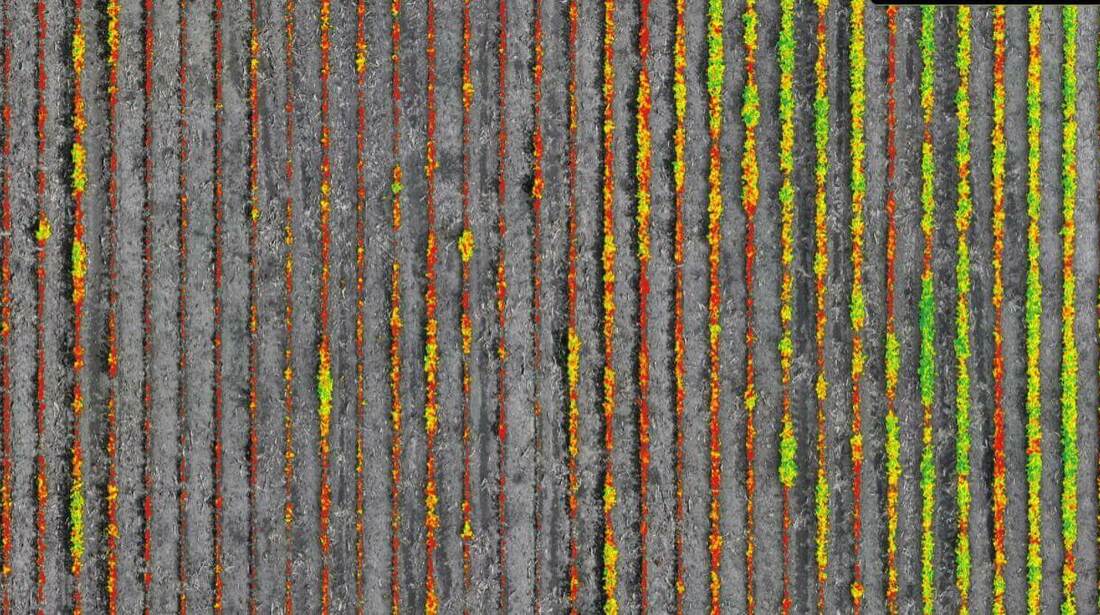
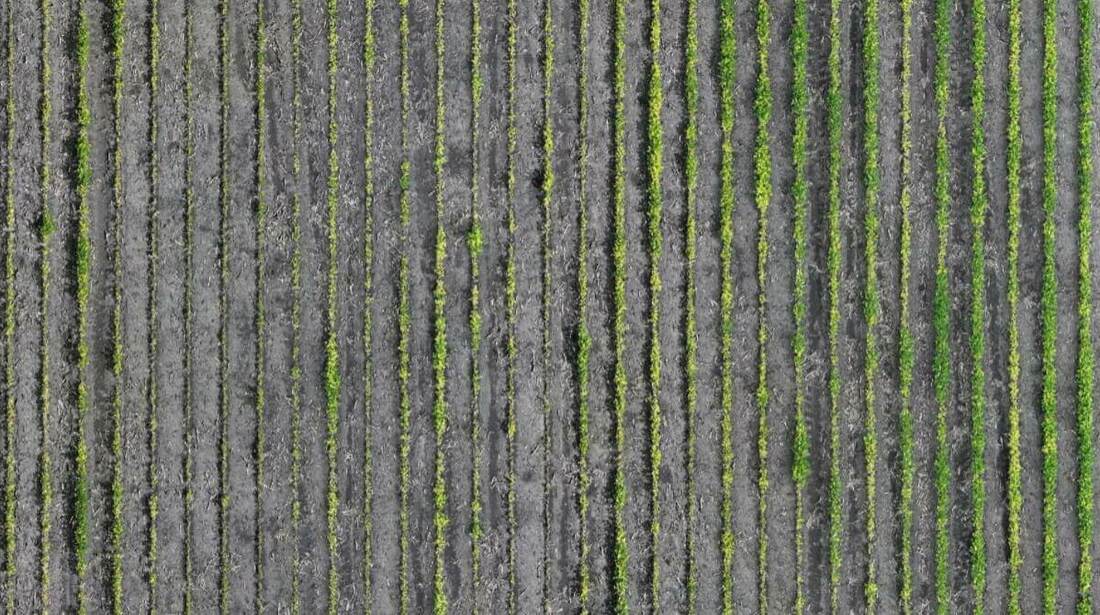
The drone detects leaf yellowing and assigns a score from one to nine. Whole-field images allow us to identify issues and communicate findings to farmers without walking the entire field. We can then quantify how much of an issue IDC is within a given field and we can measure the recovery rate of the soybeans to understand their tolerance to IDC.
The future
Stine’s research and agronomy teams are confident that this technology will only improve and become a more consistent part of our process moving forward. Paired with human insights to ensure practical and effective application, it enables objective, accurate data collection to help growers maximize their yields.
Learn more about how Stine is using drone research to elevate our product and agronomic offerings in 2026 by contact your local Stine sales rep today.