From nursery row to seed bag: How Stine® builds a better corn hybrid
October 2026Before a Stine® Seed Company corn hybrid ever reaches a grower’s field, it begins as a single row in the nursery, and a heavy amount of work goes into turning that row into a high-performing product.
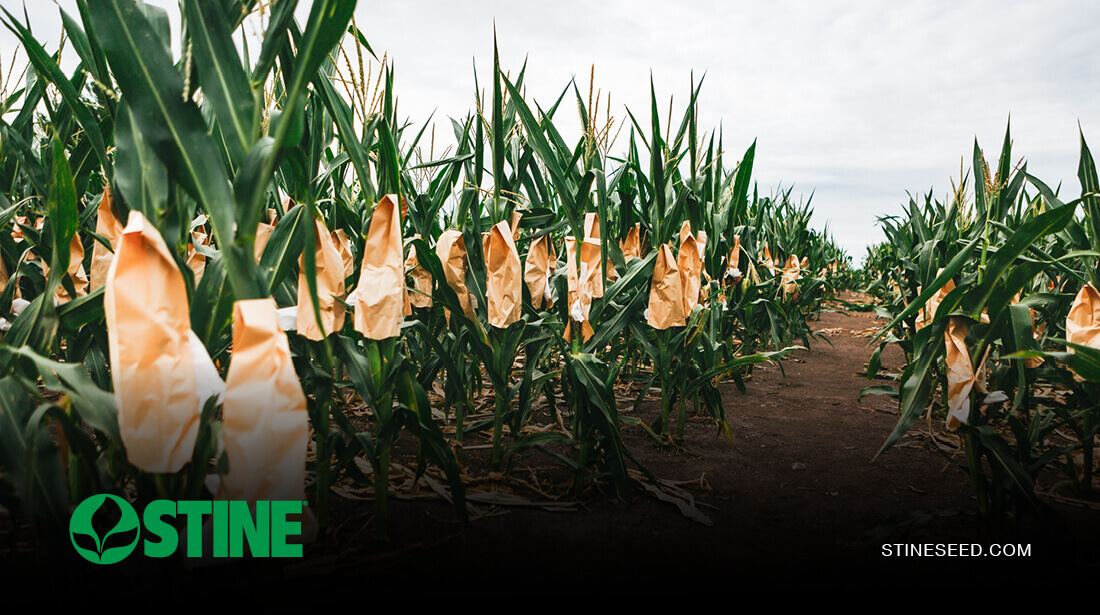
The 2026 season was our biggest year yet for the Stine Corn Nursery and corn breeding program. This year, our team expanded the nursery to 57 acres and completed nearly 930,000 hand pollinations, up from 800,000 in 2025.
For every hybrid in our lineup, there are two parent lines that started life in the Stine selfing nursery. In that nursery, all inbred self-pollinations must be controlled and done by hand, and each requires about 6–8 self-pollinations before they’re ready to be used for hybrid development. This means every Stine hybrid starts with years of careful breeding, selection and testing long before it even becomes a hybrid.
Inside the Stine Corn Nursery
The Stine Corn Nursery in Adel, Iowa, is where we maintain and develop the corn inbreds that are crossed to create hybrids for our commercial lineup and Elite Yield Trials. It's also where the next generation of Stine corn genetics takes shape.
Through the years, the nursery has increased in both size and scope — from the number of acres planted to the number of rows evaluated — allowing our team to identify the most reliable, highest-performing inbreds and genetics with the potential to become future hybrids.
The nursery has grown from 38 acres and 77,785 rows in 2023 to 57 acres and 133,272 rows today.
In the selfing nursery at Adel, inbreds are planted in groups, and planting dates are staggered about two weeks apart, beginning in May and wrapping up in June. This approach helps our team manage pollination timing and keep the breeding process moving efficiently all season.
Across our eight nurseries throughout the U.S., including Adel, we staggered planting dates about two weeks apart, beginning in May and wrapping up in June. This approach helps our team manage pollination timing and keep the breeding process moving efficiently all season.
How does Stine hand pollinate corn?
When the plants are getting ready to pollinate, the real work begins. Hand pollination is one of the most important steps in developing new corn genetics.
Stine inbred genetics are pollinated through a three-step process:
- First, before the plant produces any silk, we cover the ear shoots with a shoot bag to prevent early pollination
- Second, we place tassel bags up on each tassel as pollen shed is set to begin
- Third, workers must shake the tassel bag to get pollen released in the bag, then removing the tassel bag, remove the shoot bag on that same plant and place the tassel bag over the ear shoot. This ensures that the pollen from that inbred plant will pollinate the ear on that same plant and no foreign pollen will interfere.
Multiply those three steps across nearly 930,000 hand pollinations and it becomes a labor-intensive process.
Inbreds: the parent of every hybrid
Corn inbreds are essential to the production of making hybrids because they are the parent lines used to create them. Each hybrid requires two inbred parents: one male and one female.
Creating those parent lines take time. We will self-pollinate over 6–8 generations before achieving pure, stable inbreds that can be used to create Stine hybrids.
Four generations in one year
When you are running a corn breeding program, speed is a key element that determines how quickly you can advance new higher-yielding genetics. To complete our fast-generation breeding as quickly possible, we move new genetic lines to Guyana where we can turn four generations a year. This allows our team in Guyana to make new genetics in just two years’ time. By taking advantage of Guyana’s climate and environment, our breeders can grow and advance multiple generations in a single year. While the exact timing can vary, a potential four-generation cycle looks like this:
- Generation 1 — November–February (Plants F1, harvest F2)
- Generation 2 — March–May (Plants F2, harvest F3)
- Generation 3 — June–August (Plants F3, harvest F4)
- Generation 4 — September–November (Plants F4, harvest F5)
New inbreds line created in 2026 will spend all of 2027 in Guyana. Afterwards, the progeny from those inbred crosses will return to Iowa to create hybrids for testing.
Stine corn Elite Yield Trials
Once promising genetics have been developed, they must prove themselves in the field.
Stine is one of the few seed companies in the world with its own corn breeding program. Our goal is to build better corn faster, and our yield trials are a critical part of that process. Hybrids entering the corn Elite Yield Trials spend one to four years in research and testing to ensure they meet standards and give our team confidence in the product before it reaches the market.
In 2026, we had more than one million plots across 43 separate locations set to evaluate almost 95,000 hybrids. Our Corn Elite Trials are set up in three 15-inch rows that are 10 feet long, with 30 inches between each plot. The plots are organized into 50 entry blocks, and each entry is randomized within a given block across locations.
At first, our team will test 76,200 hybrids during the Pre-Elite Trials to see how these brand-new products adapt to stress and perform in challenging environments. From there, the hybrids that perform well will enter the Elite Yield Trials.
In 2026, the Elite Yield Trials featured 18,700 hybrids, nearly three times the 6,250 hybrids tested in 2025. This expanded testing gives our team more opportunities to identify promising genetics.
Harvest: the next step in the journey
After months of planting, pollinating and evaluating corn, the next step is harvest.
Harvest in the selfing nursery can begin as soon as 55 days after pollination and is done by hand. In 2026, the first pollinations took place July 3, meaning that material could begin being harvested as early as Aug. 27.
For our corn Elite Yield Trials, timing of harvest varies by location and is heavily influenced by weather. Harvest may begin around Sept. 8, with southern locations, such as Missouri, generally harvested first. Northern locations in the Dakotas are typically harvested later. Historically, the Frankenmuth, Michigan, location has been one of the last to finish.
Harvesting each location is another step in collecting the data and seed needed to evaluate the promising genetics and determine which hybrids will continue moving through the Stine breeding process.
From hand-pollinating nearly 930,000 plants to advancing new genetics through fast-generation breeding, yield trials and harvest, every step is designed to identify and develop corn hybrids with the performance growers need. Talk to your Stine independent sales representative for more information on our corn nursery and corn breeding process.