The latest U.S. Department of Agriculture’s Crop Progress Report notes that 23% of the nation’s corn crop is harvested in the top-producing states, with 12% listed in excellent condition, 42% good, 28% fair, 12% poor and 6% very poor. Soybean harvest is reported as 25% complete, with 11% in excellent condition, 46% good, 29% fair, 10% poor and 4% very poor.
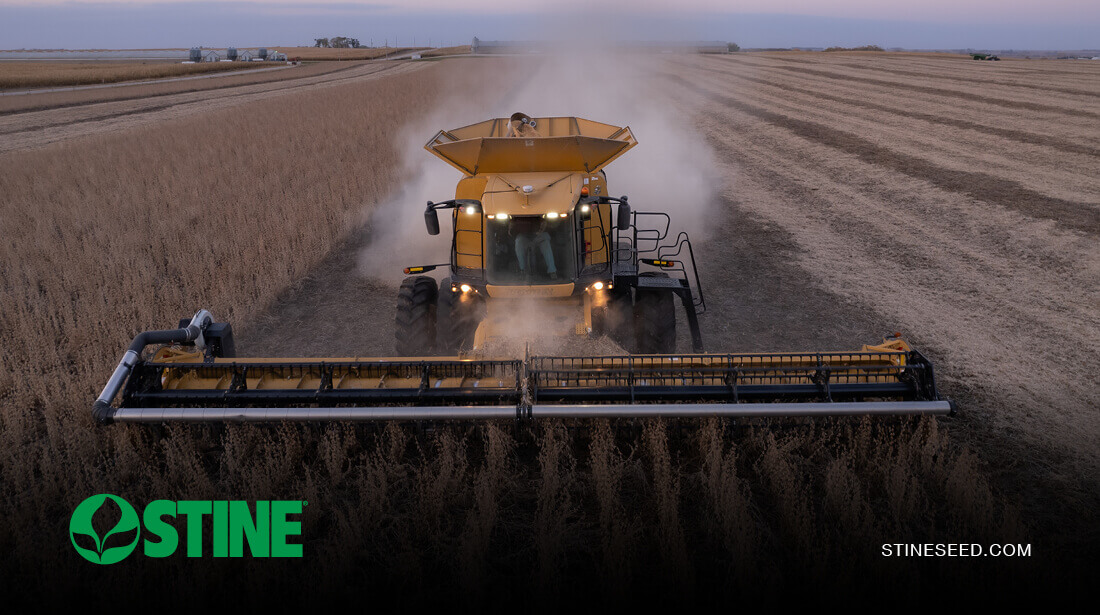
This means there’s plenty of harvest still ahead. For growers in regions coming off a wet September and the recent nor’easter, or in parts of the South and Southeast that dealt with drought, timing is essential.
“Weeks of persistent rain and saturated soils across much of the Midwest, a nor’easter hitting the East Coast and a drought in the South weren’t necessarily on growers’ bingo cards this fall, but it’s what Mother Nature delivered,” says Tyler DuBay, soybean technical agronomist for Stine® Seed Company. “As in every season, you have to roll with the punches the weather brings, but this season, checking moisture levels and crop conditions before you hit fields will be critical.”
No matter the region, Stine agronomists remind farmers not to leave yield in the field and to harvest as soon as the crop is ready.
Make every good day count
A season of extremes can delay harvest, but it shouldn’t prevent growers from getting corn and soybeans out of the ground if they’re at a harvestable moisture level.
“Few products hold up well when harvest is pushed,” says DuBay. “The longer you delay, the field losses caused by the variable weather conditions will stack up. If you have a dry, sunny weather window that allows you to get in the field, prioritize which field to take out first and then make every good day of harvest count.”
In corn, farmers typically harvest when the crop is between an 18%–25% moisture level, but they need to weigh the advantages and disadvantages of waiting. For example, waiting for corn to dry to around 20% can reduce drying costs, but it also leaves the crop vulnerable to the elements, such as high-wind events and lodging.
In soybeans, Iowa State University Extension and Outreach experts recommend harvesting around 13% moisture for optimal yield outcome, noting that anything above 13% could get docked at the elevator.
“If farmers wait too long to harvest soybeans, pod shattering can occur,” says DuBay. “Additionally, yield is left in the field with the moisture. The drier the beans, the less the yield.”
While growers are monitoring moisture levels, they shouldn’t forget the other potential field stressors caused by seasonal weather patterns and the importance of prioritizing those fields for harvest.
Issues coming off a wet season
For regions that received wet weather, every day the crop stays in the field under wet conditions adds risk. In corn, excess moisture can lead to stalk rots, which can cause lodging, while ear molds and early germination (or sprouting) in the husk can compromise grain quality.
In soybeans, farmers should watch for late-season fungal diseases, beans rotting in the pod, pod splitting, bleeding hilums and preharvest sprouting, all of which can impact grain quality come harvest.
"We're hearing reports from across the industry of corn sprouting in the husk, stalk quality issues, and soybeans rotting in the pod or showing bleeding hilums, especially in areas that experienced persistent rains over the past month," says DuBay. "Seed quality is a real concern for some growers right now, so it’s important to get harvest timing right."
Experts from Iowa State University Extension and Outreach note that purple seed stain in soybeans is an increasing concern. They add that while the fungal disease may not impact yield, it can influence grain quality, leading to price dockages at the elevator.
Stine agronomists also remind growers that heavy rains can alter grain fill and kernel structure, depending on timing, which can result in lower test weight come harvest.
Issues coming off a dry season
On the other end of the spectrum, parts of the South and Southeast experienced drought-like conditions this year, which may have resulted in some challenges at harvest.
While combines are already in the fields in much of the region, Stine agronomists caution growers who still have acres standing to be proactive and watch the weather forecast closely. If the forecast looks favorable for the foreseeable future, plan harvest accordingly to take out crops promptly.
“Hurricane Isaias is currently building in the Gulf and will bring additional moisture in the near future,” warns DuBay. “Corn plants with weakened stalks are prone to lodging and need to be prioritized to be taken out before these rains and potential winds show up.”
Regarding soybeans, DuBay advises growers to harvest dry, ready fields promptly to prevent lingering moisture from further reducing seed quality and increasing the risk of pod shattering as pods shrink and swell.
Stine agronomists recommend growers harvest fields with these issues first to avoid additional yield loss.
Prioritizing fields
Scouting is the first critical step before getting the combines rolling. Growers should monitor fields for sprouting kernels in corn or pod splitting in soybeans. They should also check for stalk quality issues in corn, leveraging the push test to ensure there are no standability concerns. Other signs to watch for include stalk breakage, ear or stalk molds, and fungal diseases.
From there, growers should decide which fields to harvest first. Stine agronomists recommend harvesting fields with the greatest risk of yield loss first. This includes fields with reduced stalk quality, fungal disease presence and seed quality concerns.
“Harvest these fields as soon as possible to limit the potential for reduced yields and reduced grain quality, for which farmers will be docked,” says DuBay.
Farmers should also weigh drying costs against field losses. Depending on the operation, a drying bill may be easier to absorb than yield left on the ground.
For fields with significant damage, growers should contact their crop insurance adviser before harvest so the damage can be properly documented.
After harvest, Stine agronomists remind growers to dry moldy or damaged grain quickly and before other grain and to keep lots or fields separate since the mold can contaminate good quality seed.
“Monitor the grain regularly throughout the winter to ensure quality issues do not get worse and find a good market to offload the crop,” says DuBay.
Growers who suspect the late-season weather extremes may impact their yield potential this harvest season should reach out to their local university extension specialist or Stine agronomist for support and to explore ways to save yield before hitting the field.
Citations
- U.S. Department of Agriculture, National Agricultural Statistics Service. "Crop Progress." Oct. 5, 2026 (week ending Oct. 4, 2026). https://esmis.nal.usda.gov/sites/default/release-files/796095/prog4026.pdf
- Mosher, Gretchen A. "Grain Quality Concerns with Recent Wet Weather." Iowa State University Extension and Outreach, Integrated Crop Management, Oct. 5, 2026. https://crops.extension.iastate.edu/post/grain-quality-concerns-recent-wet-weather
- Saeugling, Aaron. "Soybean harvest: When the time is right." Iowa State University Extension and Outreach, Integrated Crop Management, Sept. 15, 2023. https://crops.extension.iastate.edu/post/soybean-harvest-when-time-right